

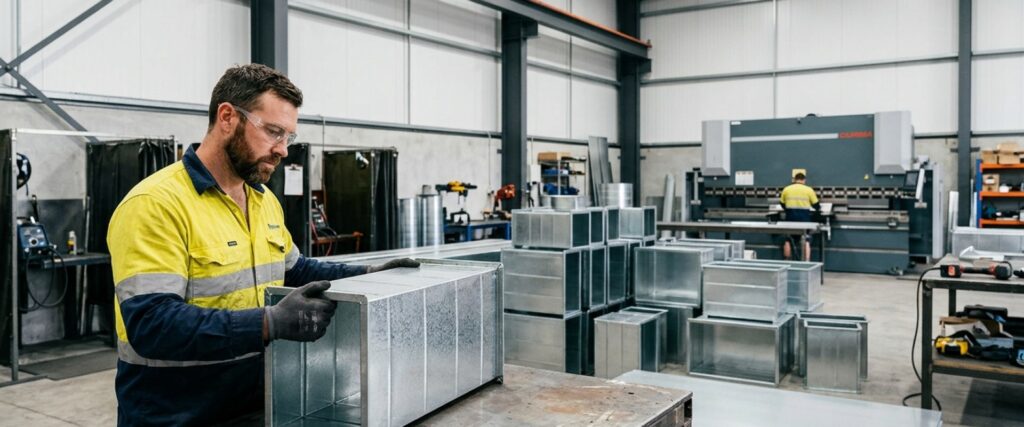
If you’re a mechanical contractor, builder or facility manager looking for an Australian custom metal parts supplier for commercial ventilation, choose a fabricator that makes the components in its own workshop. It should also know the Australian standards behind them and be able to install what it builds. King Fabrication does this from Smeaton Grange NSW, working on commercial projects across the Sydney basin. This article covers what to ask a supplier, where in-house fabrication changes the outcome, and how to brief a job so the parts fit the first time.
Key Takeaways
- Ventilation parts such as ductwork, canopies, louvres and spray booth components should be made by a fabricator that specialises in commercial ventilation, not a general metalwork shop.
- In-house fabrication and an in-house installation crew mean one party is accountable from drawing to commissioning.
- Material, duct configuration and site constraints drive cost. Treat any figure quoted without a site assessment with caution.
- Compliance claims need project-specific information. A supplier should never declare a system compliant from a generic description.
Australian custom metal parts supplier: what commercial ventilation buyers should look for
King Fabrication is based in Smeaton Grange NSW, and its focus is commercial ventilation, exhaust and ducting rather than general-purpose fabrication. That focus matters when you’re choosing an Australian custom metal parts supplier, because the term covers everything from decorative metalwork to automotive components. A ventilation job needs a supplier who understands how air moves through the parts they make.
When you assess a supplier, start with four questions. Do they make the parts themselves or pass the drawings to someone else? Do they work to the standards that govern commercial ventilation? Can they install what they fabricate? And will they put a site assessment ahead of a quote? A supplier who answers yes to all four removes most of the coordination risk from the job.
It also helps to be clear about what you’re searching for. People who type “custom metal parts manufacturing” or “custom metal parts factory” into a search engine often want very different things. For ventilation work, the useful version is a workshop that turns your specification into ducting, hoods, plenums and louvres, and then stands behind them on site.
Why in-house fabrication changes the result
King Fabrication fabricates in its own Smeaton Grange workshop rather than routinely subcontracting the work. For a contractor, the benefit is practical. If a transition piece doesn’t line up with an existing duct run, or a dimension on the drawing conflicts with a structural member, the person who made the part is the same person who can fix it. There is no relay of emails between a supplier, a fabricator and an installer.
Managing Director Mina Samaan has more than 20 years’ experience in sheet-metal duct manufacturing and installation and has run the business since 2010. That experience shows up in the small decisions: how a joint is made, how a fitting is supported, and where an access point needs to go so the system can be maintained after handover.
An integrated installation crew adds another layer. Fabrication and installation are positioned as one service, so the people on site know how the parts were built and why. If a site condition forces a change, the workshop and the crew can adjust together instead of arguing about whose scope it was.
For buyers comparing options for sheet metal fabrication Sydney wide, the local workshop also shortens the loop for revisions. Our Smeaton Grange sheet metal fabrication page outlines the workshop side of the business in more detail.
Which custom components a commercial ventilation job typically needs
Ventilation projects rarely need a single part. They need a set of parts that work as a system, and each one has its own fabrication considerations. These are the components King Fabrication works on:
- Sheet metal ducting. Rectangular, round and spiral ducting in galvanised and stainless materials, supplied either supply-only or supply-and-install where currently offered. Custom metal ductwork is where fit matters most, because every bend, offset and transition affects how the system performs.
- Commercial kitchen exhaust. Canopies, ductwork and make-up air, along with relevant compliance and certification work where it applies.
- Mechanical ventilation. Car-park and basement extraction, supply and exhaust air, plant rooms, and commercial fan replacement or upgrades.
- Spray booth ventilation. Extraction, make-up air and filter banks for paint and panel-shop applications.
- Colorbond louvres. Architectural, weatherproof and screening applications.
Each of these can be specified separately, but they often meet on the same site. A plant room, for example, may combine fans, ducting and louvres in a tight footprint. Our guide to plant room ventilation design in Sydney explains why those parts are best planned together.
Talk to the workshop before you finalise the drawings
The team is available Monday to Saturday, 7am to 8pm. Bring your drawings, your site constraints and any existing duct details, and we’ll tell you what is needed for a project-specific quote.
Ventilation parts are only as reliable as the hands that made them and the crew that fitted them.
Material choice: galvanised, stainless and Colorbond
Material selection is one of the first decisions on any custom metal ductwork job, and it affects durability, cleaning access and exposure to moisture or grease. Galvanised steel is a common choice for general supply and exhaust air runs. Stainless is used where the environment is more demanding, such as parts of a commercial kitchen exhaust. Colorbond is the material for weatherproof louvre work, where the finish has to hold up outdoors.
We won’t tell you from a generic description that one material is right for your project. The correct choice depends on what the system carries, where it runs and how it will be cleaned and maintained. Our article on the best material for ductwork sets out the trade-offs, and our team can confirm the choice against your actual site.
Compliance: what a supplier can and cannot promise
Compliance is an important part of how King Fabrication works. Current verified business information references AS 1668.2, AS 5601 and BCA requirements, with commissioning and certification provided where applicable. A fabricator who understands these documents will build and install with them in mind, and will ask the right questions about your project up front.
Being careful about claims is part of that. Whether a particular standard applies to your system depends on the building, the use and the design. A responsible supplier doesn’t declare a system compliant or non-compliant from a few lines in an email, and doesn’t promise a certification outcome before the work is assessed. If a supplier does either, treat it as a warning sign.
For kitchen-specific work, our overview of commercial kitchen exhaust compliance in Sydney explains how to approach the question properly. In every case, the sound approach is the same: provide project information, get a site assessment, and let the compliance conversation follow from real details.
What drives the cost of custom metal ductwork
People often search for the cost of custom sheet metal fabrication before they’ve settled the specification. We don’t publish dollar figures here, because no honest number exists without knowing the job. What we can do is tell you what moves the price:
- Material. Stainless and galvanised work differ in material and in how they are fabricated.
- Duct configuration. Rectangular, round and spiral runs each carry different fabrication effort, and complex transitions take more time.
- Scope. Supply-only differs from supply-and-install, and installation access can change the labour involved.
- Site constraints. Tight plant rooms, roof penetrations and restricted access all influence how parts are built and delivered.
- Accessories. Fans, filtration, acoustic treatment and make-up air add to the scope.
Our page on how much metal ductwork costs in Sydney goes through these factors in more depth. The reliable next step is a site assessment or project-specific quotation, because accurate pricing, design and certification can’t be worked out from generic information.
How to brief a fabricator so the parts fit the first time
A good brief saves time for everyone. Whether you’re working with King Fabrication or assessing another Australian custom metal parts supplier, gather the following before you ask for a quote (the article Engineering Metal Fabrication: Turning Concepts into Precision Parts | Berkeley Engineering Group sets this out in more detail):
- Drawings and schedules. Include mechanical drawings, duct layouts and any fan or equipment schedules you have.
- Existing conditions. Measurements, photos and details of any ducting that new parts must connect to.
- Material and finish requirements. State whether you need galvanised, stainless or Colorbond, and note any exposure concerns.
- Scope split. Say whether you want supply only or supply-and-install, and who handles commissioning.
- Program and access. Give delivery windows, crane or hoisting needs, and site access limits.
- Compliance context. Tell the fabricator what standards or approvals your designer or certifier has nominated.
With that information, the workshop can raise questions early, before material is cut. Raising a clash on paper costs far less than finding it on site. This is where a local, in-house fabricator earns its place, because the people reviewing your drawings are the ones who will make the parts.
Frequently Asked Questions
Does King Fabrication make custom metal parts for any industry?
No. King Fabrication specialises in commercial ventilation, exhaust and ducting. That includes commercial kitchen exhaust, mechanical ventilation, sheet metal ducting, spray booth ventilation and Colorbond louvres. It does not offer automotive exhaust systems or parts, and general-purpose fabrication is not the focus of the business.
Is the fabrication done in-house?
Yes. Fabrication is performed in the Smeaton Grange workshop rather than routinely subcontracted. King Fabrication also has its own installation crew, so fabrication and installation work as one integrated service.
Where does King Fabrication work?
The current trading footprint is the Sydney basin, approximately within 55 km of Smeaton Grange NSW where current operational information confirms that coverage. If your site is near the edge of that range, ask us to confirm before you plan around it.
Can you supply ducting without installing it?
Sheet metal ducting can be supplied either supply-only or supply-and-install where currently offered. Tell us which you need when you brief the job, and we’ll confirm what is available for your project.
Can you tell me if my existing system is compliant?
Not from a general description. Whether a system meets AS 1668.2, AS 5601 or BCA requirements depends on its design, use and installation. That judgement needs verified project and technical information, usually starting with a site assessment.
How do I get a price for custom ductwork?
Contact King Fabrication with your drawings and site details. The price depends on material, configuration, scope and site constraints, so we don’t publish figures without understanding the job first.
Choosing a local ventilation fabricator you can hold to account
The best Australian custom metal parts supplier for commercial ventilation is the one that makes the parts, understands the standards and stands behind the installation. Ventilation components are not interchangeable commodities. Each one has to fit a specific system in a specific building, and the supplier’s process decides whether it does.
A local, in-house fabricator keeps the whole chain visible: drawings, workshop, delivery and site. That visibility helps you catch problems early, keep your program moving and know who to call when something needs adjusting.
Whatever you decide, ask for a project-specific assessment, be wary of unqualified compliance promises, and brief the supplier properly. Those three habits do more for a ventilation job than any choice of brand.
Ready to discuss your ventilation components? The workshop is at 16/141 Hartley Road, Smeaton Grange NSW 2567. Send your drawings and site details, and we’ll advise on the next step.