

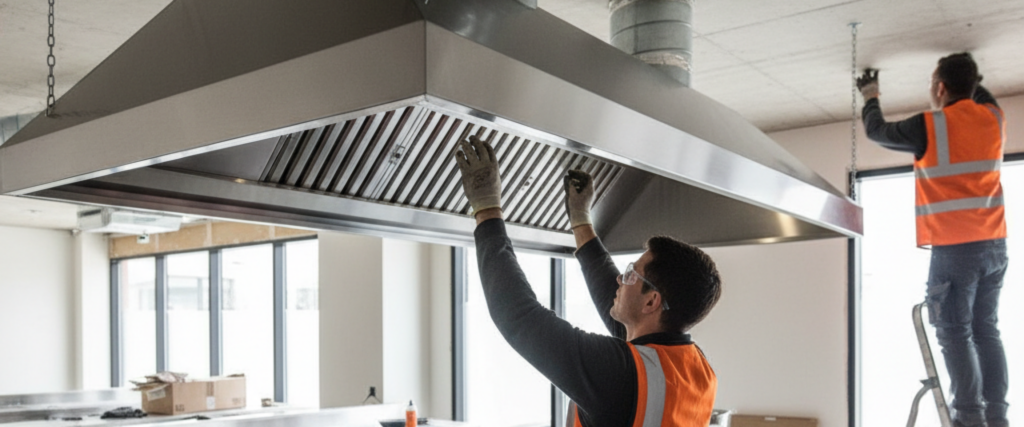
Understanding the commercial kitchen exhaust installation cost Sydney is crucial for any hospitality business planning a new fit-out or renovation. A properly designed and installed exhaust system is vital for safety, hygiene, and regulatory compliance, preventing issues like grease build-up and poor air quality. This article will break down the key factors influencing these costs, including kitchen size, hood type, ductwork complexity, and essential compliance requirements, helping you budget effectively and avoid unexpected expenses.
Key Takeaways
- Commercial kitchen exhaust installation in Sydney typically costs between $8,000 and $45,000+, depending on kitchen size, hood type, ductwork complexity, and compliance requirements.
- Australian Standards AS 1668.1 and AS 1668.2 govern ventilation design — non-compliant systems can result in failed inspections, fines, and costly retrofits.
- Getting an itemised quote from a specialist sheet metal fabricator (not a general plumber or HVAC reseller) is the single best way to control costs and avoid budget blowouts.
What Does Commercial Kitchen Exhaust Installation Actually Include?
Before diving into dollar figures, it helps to understand what you’re actually paying for. A commercial kitchen exhaust system is not a single product — it’s an engineered assembly of components that must work together to remove heat, grease-laden vapour, smoke, and odours from your cooking environment.
Core Components
- Exhaust canopy (hood) — the stainless steel hood mounted above your cooking equipment, available in wall-mounted, island, and proximity styles
- Grease filters — baffle-style filters that capture grease particles before they enter the ductwork
- Ductwork — galvanised or stainless steel ducting that channels extracted air from the hood to the building exterior
- Exhaust fan — typically a roof-mounted or external centrifugal fan sized to the system’s airflow requirements
- Make-up air system — supplies replacement air to the kitchen to maintain balanced pressure
- Fire suppression integration — connections for your kitchen fire suppression system, often required under BCA provisions
Each of these elements carries its own material and labour cost. The total price also includes engineering design, fabrication, installation labour, and compliance certification — which is why quotes can vary so dramatically between providers. Understanding the commercial kitchen exhaust installation cost Sydney involves considering all these factors.
Typical Cost Ranges for Commercial Kitchen Exhaust in Sydney
Every kitchen is different, but here are realistic ballpark ranges based on what Sydney fabricators (including our team at King Fabrication) see across hundreds of projects each year. All figures are installed costs, excluding GST.
By Kitchen Size
- Small café or takeaway (1–2 cooking appliances, under 30m²): $8,000 – $15,000
- Mid-size restaurant (3–5 appliances, 30–80m²): $15,000 – $28,000
- Large commercial kitchen (hotel, club, hospital — 6+ appliances, 80m²+): $28,000 – $45,000+
- Multi-zone or industrial kitchens (food manufacturing, major venues): $50,000 – $90,000+
By Hood Type
- Wall-mounted canopy (most common): $2,500 – $6,500 per linear metre, installed
- Island canopy (open on all sides, requires more airflow): $4,000 – $9,000 per linear metre
- Proximity / condensate hood (for dishwashers, steamers): $2,000 – $4,500 per unit
These ranges assume standard stainless steel construction and straightforward access for ductwork. Complex builds push costs toward the higher end — or beyond it entirely.
Factors That Influence Your Exhaust Installation Cost
If you’ve received two quotes that are $20,000 apart, it’s usually because one or more of the following variables differs significantly between proposals.
Ductwork Run Length and Complexity
A short, straight duct run from the hood through the roof costs a fraction of what a long run with multiple bends, fire dampers, and structural penetrations requires. Multi-storey buildings, heritage-listed facades, and basement kitchens all add complexity — and cost. Ductwork alone can account for 25–40% of the total installation price.
Access and Site Conditions
Is the kitchen in a brand-new shell with open ceilings, or a cramped existing tenancy with asbestos-containing materials overhead? Difficult access means more labour hours, scaffolding, and potentially after-hours work if you’re in a busy shopping centre or strata building.
Material Specification
Standard galvanised steel ductwork is the most economical. However, grease ducts within the kitchen must be stainless steel under AS 1668.1. Some councils and certifiers also require stainless for the full run. The material upgrade from galvanised to 304-grade stainless can add 30–50% to ductwork costs.
Make-Up Air Requirements
Every cubic metre of air you extract must be replaced. In cooler months or air-conditioned environments, that replacement air may need to be tempered (heated or cooled), adding mechanical equipment and energy costs to the project.
The exhaust hood is only 20% of the project — ductwork, make-up air, and compliance certification are where budgets are won or lost.
Compliance and Australian Standards You Must Meet
This is the area where cutting corners costs the most. A non-compliant exhaust system can mean a failed council inspection, an invalid occupancy certificate, or — worst case — a fire that your insurance won’t cover.
Key Standards and Codes
- AS 1668.1 — Fire and smoke control in buildings. Governs fire damper placement, duct material within fire compartments, and access panel requirements.
- AS 1668.2 — Ventilation design and performance. Specifies minimum airflow rates based on cooking equipment type, hood geometry, and kitchen layout.
- National Construction Code (NCC / BCA) — Overarching building code that references AS 1668 and sets additional requirements for commercial kitchens.
- Local council DAs and CDCs — Many Sydney councils (City of Sydney, Inner West, Canterbury-Bankstown) impose additional conditions around noise, odour discharge height, and proximity to residential boundaries.
What Compliance Adds to the Cost
Budget roughly $1,500 – $4,000 for mechanical engineering design and certification by a qualified engineer. Some projects also require acoustic reports ($800 – $2,000) and odour assessments, particularly in mixed-use developments. These aren’t optional extras — they’re prerequisites for your occupation certificate.
Ready to Get an Accurate Quote for Your Kitchen?
King Fabrication provides fully itemised, obligation-free quotes for commercial exhaust systems across Sydney — from small cafés to large-scale industrial kitchens.
How to Get an Accurate Quote for Your Project
The quality of your quote depends on the quality of information you provide. Here’s what to prepare before you pick up the phone.
Information Your Fabricator Needs
- Floor plan with kitchen equipment layout (even a rough sketch helps)
- Equipment schedule — brand, model, and kW rating of each cooking appliance
- Ceiling height and any obstructions (beams, services, existing ductwork)
- Roof access details — flat or pitched roof, access hatch, height restrictions
- Council or certifier requirements — any specific conditions of consent you’ve already received
Red Flags in Quotes
- A single lump-sum figure with no breakdown — you can’t compare what you can’t see
- No mention of AS 1668 compliance or engineering certification
- Pricing that seems 40%+ below the market — often means thinner-gauge steel, undersized fans, or excluded items (fire dampers, make-up air, commissioning)
- No site visit offered — accurate pricing for exhaust systems requires eyes on the space
At King Fabrication, we provide line-item quotes that clearly separate materials, fabrication, installation labour, and certification costs. No surprises at practical completion.
Common Mistakes That Blow Out Exhaust Installation Budgets
We’ve seen these patterns repeat across hundreds of Sydney kitchen fit-outs. Avoiding them can save you thousands.
1. Designing the Kitchen Before the Exhaust
If you finalise your kitchen layout and then bring in the exhaust contractor, you’ll often find the optimal duct route is blocked by structural elements, existing services, or another tenant’s space. Engage your fabricator during the design phase — it’s free at the quoting stage and can save tens of thousands in rework.
2. Choosing the Cheapest Quote Without Checking Scope
The lowest price frequently excludes critical items: fire dampers, make-up air, electrical connections, commissioning, or certification. When those costs surface during construction, your “savings” evaporate — plus you’re now locked in with a contractor who under-quoted.
3. Ignoring Make-Up Air
An exhaust system without adequate make-up air creates negative pressure in the kitchen. Doors slam shut, gas appliances backdraft, and the exhaust fan itself underperforms. Retrofitting make-up air after the fact typically costs 30–50% more than including it from the start.
4. Skipping the Engineer
Some operators try to save $2,000–$3,000 by skipping the mechanical engineer and relying on the installer’s calculations alone. This works until the certifier rejects the system, the council issues a notice, or — in the worst case — a fire investigation reveals the system doesn’t meet AS 1668.
Why Sydney Projects Often Cost More Than Regional NSW
If you’ve seen lower quotes for similar work in Wollongong or Newcastle, there are genuine reasons Sydney commands a premium.
- Higher labour rates — Sydney trades command $85–$120/hour versus $65–$90 regionally
- Restricted site access — CBD and inner-city sites often require after-hours delivery, traffic management plans, and crane lifts for rooftop equipment
- Stricter council conditions — City of Sydney and surrounding LGAs frequently impose noise and odour discharge requirements that add acoustic attenuation or carbon filtration to the scope
- Strata and building management approvals — multi-tenancy buildings add coordination time and sometimes require engineering certification for roof penetrations
None of these are reasons to accept an inflated quote — but they are reasons a Sydney project legitimately costs more than the same scope in a greenfield regional development.
For further information, see business.gov.au.
Frequently Asked Questions
How long does a commercial kitchen exhaust installation take?
Most installations take 3–7 working days on site, depending on the system size and complexity. However, the full timeline — including design, fabrication, and council approvals — is typically 4–8 weeks from signed quote to commissioning. Early engagement during the fit-out design phase can compress this significantly.
Do I need a mechanical engineer for a small café exhaust system?
In most cases, yes. While a small system is simpler to design, your building certifier will almost always require an AS 1668.2 compliance certificate signed by a qualified mechanical engineer before issuing an occupation certificate. Skipping this step risks delays and additional costs at the final inspection stage.
Can I reuse the existing exhaust system from the previous tenant?
Sometimes, but it depends on condition and compatibility. The existing system must suit your specific cooking equipment type and output, meet current AS 1668 requirements, and pass a condition assessment. If the previous tenant ran a sandwich bar and you’re installing a charcoal grill, the existing system is almost certainly undersized. A specialist can assess reusability during the quoting phase.
What’s the difference between a sheet metal fabricator and a HVAC company for this work?
A specialist sheet metal fabricator like King Fabrication designs and builds the ductwork and canopies in-house, giving you direct control over quality, lead times, and cost. Many HVAC companies subcontract fabrication to a third party, adding margin and reducing accountability. For commercial kitchen exhaust specifically, a fabricator with kitchen ventilation experience is usually the better choice.
Are there ongoing maintenance costs I should budget for?
Yes. Commercial kitchen exhaust systems require professional cleaning every 3–12 months (depending on cooking volume and type), typically costing $400–$1,200 per service. Grease filters should be cleaned weekly in-house. Fan belts, bearings, and motors need annual inspection. Budget roughly $1,500–$3,000 per year for a mid-size restaurant system.
Visit King Fabrication Today
Whether you’re fitting out a new café in Surry Hills or upgrading the exhaust system in a Parramatta RSL kitchen, our Sydney-based team will give you a straight answer on commercial kitchen exhaust installation cost Sydney, timeline, and compliance — no obligation.