

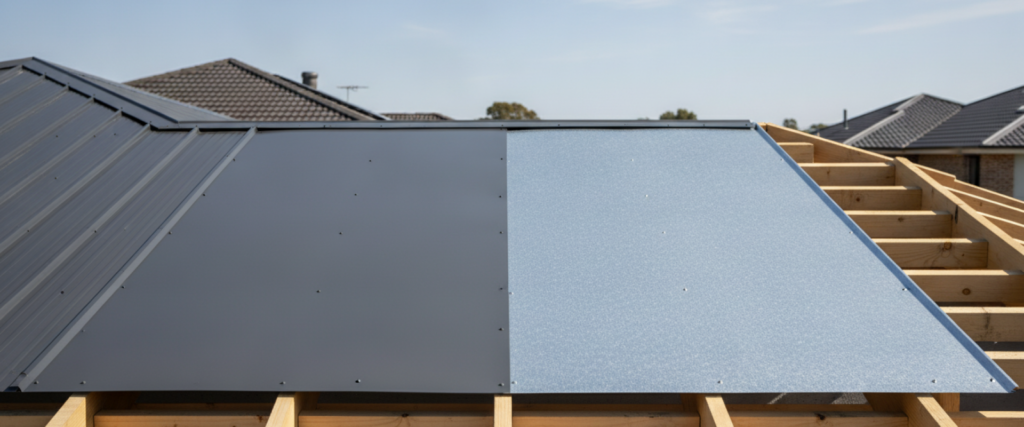
Choosing the right roofing material is a critical decision for any build, impacting everything from aesthetics and durability to long-term cost. In Australia, two names frequently come up: Colorbond and Zincalume steel. Both are premium steel products from choosing the right metal for your project, manufactured by BlueScope Steel, but they serve different purposes and offer distinct advantages. Understanding their core differences is key to making an informed choice for your residential, commercial, or industrial project across Sydney. This comparison of Colorbond vs Zincalume roofing will help. BlueScope Steel Products for …’s guidance on cOLORBOND® steel | BlueScope Steel Products for Australia sets this out in more detail.
Key Takeaways
- Colorbond steel is pre-painted, offering a wide colour range and superior aesthetic appeal, ideal for residential and architecturally-driven commercial projects.
- Zincalume steel is an unpainted, durable zinc-aluminium alloy-coated steel, prized for its cost-effectiveness and robust performance in industrial or less visible applications.
- Both products offer excellent durability, but Colorbond generally comes with a longer warranty due to its advanced paint system.
- Zincalume is typically more affordable upfront, while Colorbond’s price premium is justified by its aesthetic versatility and enhanced protection.
- Choosing between them depends on project aesthetics, budget, environmental conditions (especially coastal), and desired lifespan, with King Fabrication supplying both for Sydney builds. Here’s how to choose between Colorbond vs Zincalume roofing.
What Is Colorbond Steel?
Colorbond steel is a pre-painted steel product developed by BlueScope Steel, specifically engineered for Australian conditions. It’s renowned for its extensive colour palette, offering over 20 core colours inspired by the Australian landscape, from classic neutrals to vibrant contemporary shades. This aesthetic versatility makes it a popular choice for residential roofing, wall cladding, and architectural features where visual appeal is paramount.
The composition of Colorbond steel involves a multi-layered protection system. At its core is a steel base, which is then coated with a Zincalume alloy. This Zincalume layer provides exceptional corrosion resistance. On top of this, a thin pre-treatment layer is applied, followed by a corrosion-inhibiting primer, and finally, a topcoat of baked-on exterior paint. This paint system, which often includes Thermatech solar reflectance technology, enhances durability, colour stability, and energy efficiency by reflecting more of the sun’s heat.
Colorbond is manufactured to strict Australian standards, including AS 1562.1 for design and installation, ensuring it meets the rigorous demands of the National Construction Code. Its advanced coating and paint technology provide superior resistance to chipping, peeling, and cracking, making it a robust and long-lasting material suitable for diverse applications, from coastal homes to commercial buildings. This makes it a strong contender in any discussion of Colorbond vs Zincalume roofing.
What Is Zincalume Steel?
Zincalume steel, also a BlueScope Steel product, is an unpainted, metallic-coated steel known for its exceptional corrosion resistance and strength. Unlike Colorbond, Zincalume does not feature a pre-applied paint finish. Its distinctive appearance is a matte metallic silver, which naturally weathers over time to a softer grey.
The composition of Zincalume is what gives it its unique properties. It consists of a steel base coated with an alloy of 55% aluminium, 43.5% zinc, and a small amount of silicon. This specific zinc-aluminium coating provides a dual protection mechanism: the aluminium component offers a passive barrier against corrosion, while the zinc provides galvanic protection, sacrificing itself to protect the underlying steel at cut edges or scratches. This makes Zincalume incredibly durable and suitable for demanding environments.
Zincalume is widely used in commercial, industrial, and agricultural applications where durability, cost-effectiveness, and a raw metallic finish are preferred over a decorative colour. It performs exceptionally well as roofing and wall cladding for sheds, factories, warehouses, and other structures where aesthetic considerations are secondary to robust, long-lasting performance. Its inherent resistance to corrosion makes it a reliable choice for areas exposed to harsh elements, and a viable alternative in many Colorbond vs Zincalume roofing comparisons.
While Colorbond offers aesthetic versatility and enhanced thermal performance, Zincalume provides a cost-effective, high-strength solution with a classic metallic finish, making both indispensable in Australian construction.
Comparison Table: Colorbond vs Zincalume Roofing
To help you decide, here’s a side-by-side comparison of Colorbond vs Zincalume roofing:
| Feature | Colorbond Steel | Zincalume Steel |
|---|---|---|
| Aesthetic / Finish | Pre-painted, wide range of colours, modern and vibrant appearance. | Unpainted, matte metallic silver finish, weathers to a soft grey. Industrial/raw look. |
| Composition | Steel base + Zincalume coating + pre-treatment + primer + baked-on exterior paint. | Steel base + 55% Aluminium, 43.5% Zinc, 1.5% Silicon alloy coating. |
| Durability & Lifespan | Excellent, enhanced by paint system. Long-lasting colour and protection. Typical lifespan 20-30+ years. | Excellent corrosion resistance and strength. Typical lifespan 20-30+ years. |
| Warranty Coverage | Comprehensive BlueScope warranties, often up to 30 years for roofing, depending on application and location. | BlueScope warranties, typically 15-25 years for roofing, depending on application and location. |
| Relative Cost | Roughly 15–30% more per square metre than Zincalume, depending on profile and colour. The premium covers the five-layer coating process (pre-treatment, corrosion-inhibiting primer, baked-on topcoat), Thermatech solar reflectance technology, and the logistics of maintaining a 22+ colour production range. | Typically the most economical BlueScope steel roofing option. The single alloy coating requires no paint line, keeping production costs down — making it especially attractive for large-area coverage on sheds, warehouses, and agricultural buildings where colour adds no functional value. |
| Application Suitability | Residential roofing & cladding, architectural projects, commercial buildings where aesthetics matter. | Industrial sheds, factories, warehouses, agricultural buildings, concealed applications, cost-driven projects. |
| Coastal & Corrosion Performance | Excellent. Standard Colorbond is warranted in environments up to high corrosivity — urban, light-industrial, and coastal sites beyond roughly 1 km from breaking surf. For properties closer to the ocean, Colorbond Ultra is engineered with a thicker, more corrosion-resistant coating to handle severe marine exposure within 500 m of the waterline. | Strong in low-to-medium corrosivity environments (rural, suburban, inland industrial). However, standard Zincalume is generally not warranted within roughly 500 m to 1 km of breaking surf, depending on elevation and wind exposure. For these locations, specifying Colorbond or Colorbond Ultra avoids premature corrosion and preserves warranty coverage. |
Is the Colorbond Colour Premium Worth It?
Ask yourself three questions: Will the roof or cladding be visible from the street, neighbouring properties, or a public-facing elevation? Does resale value matter? A colour-matched Colorbond roof adds measurable street appeal to residential properties. Are there council or body-corporate requirements? Many residential developments across Sydney mandate a pre-finished, colour-coordinated roofing product. If two or more answers point toward aesthetics, Colorbond is the justified choice. If none do — say, a rear warehouse roof in an industrial estate — Zincalume delivers the same structural performance for 15–30% less. This helps make the right choice between Colorbond vs Zincalume roofing.
Unsure Which Roofing Steel Is Best?
Speak with our experts at King Fabrication for tailored advice on Colorbond and Zincalume for your Sydney project. We’ll help you weigh the options.
When to Choose Colorbond
Choosing Colorbond steel is often the preferred option when aesthetics, long-term performance, and specific environmental factors are key considerations for your project. Here are the scenarios where Colorbond shines:
- Residential Builds: For homes across Sydney, Colorbond’s vast colour range allows for seamless integration with architectural styles and landscaping, enhancing curb appeal and property value. This is a key factor when considering Colorbond vs Zincalume roofing.
- Architectural and Commercial Projects: When the roof or cladding is a prominent visual element, such as on modern commercial buildings, schools, or public facilities, Colorbond offers the design flexibility to achieve a specific aesthetic vision.
- Coastal Environments: For properties within roughly 1 km of breaking surf — common across Sydney’s eastern suburbs, Northern Beaches, and Sutherland Shire — standard Colorbond outperforms Zincalume, and Colorbond Ultra is recommended for sites closer than 500 m to the water. Using the wrong material in these zones risks premature corrosion and may void your BlueScope warranty.
- Energy Efficiency: Colorbond with Thermatech technology can reflect more solar heat, potentially reducing reliance on air conditioning and lowering energy bills, making it a smart choice for sustainability-focused projects.
- Warranty Assurance: BlueScope offers extensive warranties for Colorbond, often up to 30 years for roofing, providing peace of mind regarding the material’s durability and colour stability.
When to Choose Zincalume
Zincalume steel is an excellent choice when robust performance, cost-effectiveness, and a utilitarian aesthetic are the primary drivers for your build. Consider Zincalume in these situations:
- Industrial and Agricultural Sheds: For factories, warehouses, workshops, farm sheds, and other industrial structures, Zincalume provides a durable, low-maintenance, and highly corrosion-resistant roofing and cladding solution that stands up to demanding conditions.
- Budget-Conscious Projects: Zincalume typically costs 15–30% less per square metre than Colorbond, making it an attractive option for large-scale industrial or commercial projects where cost efficiency is a significant factor. The saving compounds quickly on a 500 m² warehouse roof compared to a 150 m² residential roof. This is a primary driver in the Colorbond vs Zincalume roofing decision.
- Concealed or Less Visible Applications: If the roofing or cladding will not be a primary aesthetic feature, such as on concealed roofs, internal linings, or areas not visible to the public, Zincalume’s metallic finish is perfectly suitable without the need for a painted surface.
- Inland and Suburban Locations: Zincalume’s zinc-aluminium alloy coating provides exceptional protection in low-to-medium corrosivity environments — rural, suburban, and light-industrial areas well inland or beyond roughly 1 km from breaking surf. For sites closer to the ocean, switch to Colorbond or Colorbond Ultra to stay within warranty and avoid accelerated corrosion.
- Structures with a Raw or Industrial Aesthetic: For builds aiming for a modern industrial or raw metallic look, Zincalume’s natural finish can be a deliberate design choice, offering a distinct aesthetic character.
Zincalume is a practical and resilient material that delivers long-lasting performance without the added cost of a pre-painted finish, making it ideal for many commercial and industrial applications where durability trumps decorative colour. This makes it a strong alternative in the Colorbond vs Zincalume roofing debate.
Frequently Asked Questions
What is the core difference between Colorbond and Zincalume steel?
The core difference lies in their finish. Colorbond is pre-painted Zincalume steel, offering a wide range of colours and an aesthetic appeal. Zincalume is unpainted steel with a zinc-aluminium alloy coating, giving it a raw metallic finish. This is the primary distinction when comparing Colorbond vs Zincalume roofing.
Which product is more durable?
Both Colorbond and Zincalume offer excellent durability and corrosion resistance. Colorbond’s multi-layered paint system provides an additional protective barrier, enhancing its lifespan and colour stability. Zincalume’s metallic coating is inherently robust against corrosion.
Is Colorbond more expensive than Zincalume?
Yes — expect Colorbond to cost roughly 15–30% more per square metre than Zincalume, depending on the profile and colour selected. The premium pays for the multi-layer paint system (pre-treatment, corrosion-inhibiting primer, baked-on topcoat), Thermatech solar reflectance technology, and the 22+ colour production range. Zincalume’s single alloy coating skips the paint line entirely, which is why it costs less — and why it is often the smarter pick for large-area industrial roofing where colour is unnecessary. This is a critical cost factor in the Colorbond vs Zincalume roofing decision.
Can Zincalume be painted?
While Zincalume can theoretically be painted, it’s generally not recommended as a DIY project. The surface requires specific preparation and compatible paint systems to ensure adhesion and durability. If a coloured finish is desired, Colorbond is the purpose-built solution.
Which is better for coastal areas?
Both perform well in moderate coastal environments beyond roughly 1 km from breaking surf. Closer than that — common across Sydney’s coastal suburbs — standard Zincalume is generally not warranted and risks early corrosion. Standard Colorbond handles most coastal sites well, while Colorbond Ultra is recommended within 500 m of breaking surf. Always check BlueScope’s warranty conditions for your specific distance from the coast, as specifying the wrong material can void coverage and lead to premature failure. This is a key factor when evaluating Colorbond vs Zincalume roofing for coastal builds.
Where can I source Colorbond and Zincalume in Sydney?
King Fabrication, located in Smeaton Grange, supplies both Colorbond and Zincalume roofing materials across Sydney. We provide expert advice and high-quality products suitable for residential, commercial, and industrial projects. To request a quote, call us directly or visit our contact page — we can help you choose the right product for your environment, project type, and budget, guiding your Colorbond vs Zincalume roofing decision.
Conclusion
The choice between Colorbond vs Zincalume roofing ultimately hinges on your project’s specific needs, budget, and aesthetic aspirations. Colorbond steel offers unparalleled aesthetic versatility, enhanced protection, and energy efficiency, making it ideal for residential and visually prominent commercial applications. Zincalume steel, with its robust unpainted finish and cost-effectiveness, excels in industrial, agricultural, and budget-driven projects where durability and performance are paramount.
Both are high-quality BlueScope Steel products built to withstand Australia’s harsh conditions, compliant with the National Construction Code. By comparing their durability, relative cost, aesthetic differences, and application suitability, you can confidently identify which product suits your specific project type and environmental considerations, ensuring a long-lasting and appropriate roofing solution for your build.
Related resources
- Colorbond Roofing Benefits for Sydney Building Projects
- Colorbond Roofing Suppliers Sydney
- Roofing Supplier Campbelltown
- Roofing Supplier
- 6 Signs You Need Roof Replacement in Sydney
- 5 Major Benefits of Hiring a Roofing Supplier in Sydney
- How to Choose the Best Roofing Supplier in Sydney
- Colorbond Louvres Quote
- Steel & Metal Fabrication in Balmain
- Why Commercial Builders Choose Structural Steel for Large-Scale Projects
Visit King Fabrication Today
Ready to choose the perfect Colorbond or Zincalume roofing for your project? Get a personalised quote and expert advice from King Fabrication, Sydney’s trusted roofing supply services.